

What is Data-Driven Decision Making?

13 January, 2026
Share this article
Table of Contents
Summary: Relying only on intuition is no longer enough in complex and fast-changing work environments. Data-driven decision making helps teams structure conversations, reduce risk, and move forward with greater clarity without losing the human perspective. In this article, you will learn what a data-based reason really means, how to identify useful metrics, real-world examples of data-driven decision making and the benefits of using data to support better decisions.
I once sat in a meeting where everyone had a different opinion on which management technique worked best at the office. All of them sounded reasonable. Each perspective was based on past experience, intuition, or “what had worked before.”
The problem was that no one could actually prove their proposal was the best option. The conversation dragged on, the decision was postponed, and the team walked out more confused than when they walked in.
Unfortunately, situations like this are more common than we like to admit.
When there is no concrete data on the table, decisions turn into endless debates where the loudest voice often carries more weight than the strongest argument. This is not a lack of commitment or capability. It is a lack of shared evidence.
That is where data-driven decision making comes in. Not to eliminate human judgment or experience, but to organize it.
Data helps move conversations from “I think” to “this is what we are seeing,” bringing structure to discussions that would otherwise rely only on perception.
If you work in HR, leadership, or team management, you know how costly it can be to make poor decisions or delay important ones.
Throughout this article, you will learn what data-driven decision making really means, what a data-based reason looks like in practice, and how to use the right information without falling into analysis paralysis.
What Is a Data-Based Reasoning Process?
Before talking about tools, metrics, or dashboards, it is important to clarify a key concept. Data-driven decision making consists of an argument or decision supported by observable, measurable, and verifiable information rather than just opinions, intuition, or personal experience.
In practice, this means that when you make a decision, you can clearly explain why you made it and what information you relied on. It is not “I believe this will work,” but “the data shows this option has a higher probability of working.”
A Brief Historical Overview
For a long time, decision making inside organizations was dominated by hierarchy and experience.
Leaders relied heavily on intuition and past success. In relatively stable environments, this approach made sense, especially considering back then there was less data available and change happened slowly.
As digital systems expanded, however, organizations around the world began generating massive amounts of data.
At first, most companies simply stored it without knowing how to use it. Only when analytical tools became more accessible did data truly start influencing decisions.
In recent years, with hybrid work, distributed teams, and rapid change, intuition alone has stopped being enough.
Organizations now need decisions that are faster, more transparent, and less dependent on individual perception. This is when data-driven decision making shifted from a competitive advantage to a basic necessity.
Why Data-Driven Decision Making Matters Today
Today, data-driven decision making in business, education, and healthcare is not just a trend. It is a direct response to complexity. Teams are more diverse, environments change quickly, and mistakes are more expensive.
Some key reasons why this approach matters today include:
- Reduces subjectivity in critical decisions
- Speeds up the decision making process
- Improves alignment across teams
- Reduces unnecessary risk
- Supports decision making in hybrid and distributed teams
- Makes decisions more transparent and defensible
It is important to pause here and be clear: data does not replace human experience.
Instead, it complements it by providing structure, context, and clarity to decisions that once depended too heavily on intuition alone.
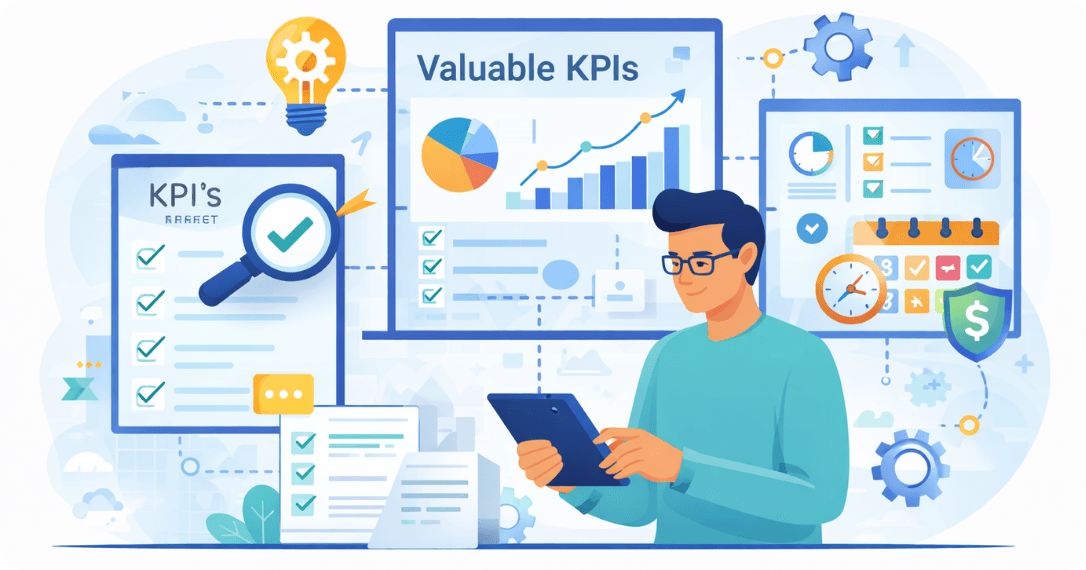
Data Collection for Decision Making: How to Find the Right Metrics
Talking about data is easy. Knowing which data actually helps you decide is harder.
Many organizations collect large volumes of information and still make decisions with uncertainty. The problem is not a lack of data, but a lack of focus.
Data collection for decision making is not about measuring everything. It is about identifying which information truly adds clarity and reduces doubt.
A useful starting point is always a clear question. Without a question, data rarely helps.
For example, asking “How is the team doing?” is vague. Asking “What is affecting on-time delivery this quarter?”, on the other hand, immediately guides which metrics matter and which do not.
How to Choose Metrics That Support Decisions
Not all metrics are equally useful. Some describe the past, others help anticipate what comes next. In the data-driven decision making process, the most valuable metrics share a few traits:
- They are aligned with the problem, not vanity metrics
- They are actionable and lead to clear next steps
- They are easy to understand across teams
- They can be analysed over time to identify trends
Common Mistakes in Data Collection
Even with good intentions, organizations often fall into predictable traps:
- Measuring too many things at once: When everything is measured, nothing stands out. Teams end up overwhelmed with dashboards but still unsure what to act on.
- Tracking metrics that are not linked to decisions: Data without a decision attached quickly loses value. If a metric does not influence action, it becomes noise rather than guidance.
- Relying on outdated data: Old data reflects past realities, not current ones. Decisions based on outdated information often solve problems that no longer exist.
- Lacking shared definitions for metrics: When teams interpret the same metric differently, alignment breaks down. Clear definitions are essential for meaningful discussion.
- Confusing correlation with causation: Just because two things move together does not mean one causes the other. Acting on false assumptions can create bigger problems than the original one.
When teams lose trust in the numbers, they stop using them. Data then becomes noise instead of guidance.
Tips for Using Data in Decision Making
Having data does not automatically lead to better decisions. The difference lies in how you interpret it and act on it.
- Start with a clear question: Data is most useful when it answers a specific question. Without clarity on what you are deciding, analysis quickly becomes unfocused. A good question keeps teams aligned and prevents endless exploration.
- Combine data with human context: Numbers show patterns, but people explain why those patterns exist. Conversations, observations, and feedback give meaning to the data. This balance is especially important in HR and people management.
- Focus on a small set of well-defined indicators: Fewer metrics create more clarity. When teams track only what truly matters, they are more likely to act consistently. Focus drives momentum.
- Use data to learn, not to punish: If data is perceived as a control mechanism, trust disappears. When used for learning and improvement, it encourages openness. Culture determines whether data empowers or intimidates.
- Decide and act even when data is imperfect: Waiting for perfect information delays progress. Most decisions require acting with partial data and reviewing results afterward. Data-driven decision making is about managing uncertainty, not eliminating it.
Effective data-driven decision making balances evidence with judgment.
A Concrete Example of Evidence-Based Decision Making
Imagine a scenario where a hybrid team started noticing something was off.
No one said it out loud at first, but projects were consistently slipping. Not in dramatic ways, just small delays that kept stacking up week after week. Meetings were still happening, people looked busy, and commitment was not the issue. Still, something was not working.
Leadership had several hypotheses. Some believed remote work was the problem, while others thought the team lacked discipline.
All of these opinions sounded reasonable, but none of them were backed by evidence.
Instead of making a rushed decision, the team chose to observe before acting.
Defining the problem
The first step was turning a vague feeling into a concrete problem. They defined it as: “Hybrid team projects are experiencing recurring delays during cross-team coordination phases.”
That single sentence changed the conversation. The issue was no longer abstract. It was specific and measurable.
What data they decided to analyze
This is where the data-driven decision making process began. They did not measure everything, only what mattered. Over four weeks, they looked at:
- Time between partial deliveries
- Number of reported blockers per week
- Participation in planning sessions
- Frequency of priority changes mid-sprint
Nothing overly complex. Just data that reflected how work actually flowed.
What the data revealed
Once the information was reviewed, a clear pattern emerged.
- Delays happened during coordination, not execution
- Teams that met in person at least once a month had fewer blockers
- Priority changes increased during weeks without alignment spaces
The evidence pointed to one conclusion: the issue was not hybrid work itself, but the lack of intentional alignment moments.
The decision they made
With data on the table, the team made a simple but well-supported decision:
- Set two in-person or coworking days per month focused on planning
- Reduce operational meetings and prioritize strategic alignment
- Track blockers and delays again the following quarter
They did not change tools. They did not change people. They simply changed how decisions were made.
The outcome
Two months later, the data showed clear improvements.
- Fewer unexpected priority changes
- Reduced cross-team blockers
- More consistent delivery
The team did not just solve the problem. They learned that when decisions are supported by clear data, the path to a solution becomes much shorter.

Data-Driven Decision Making in Different Sectors
Seeing diverse real applications makes the concept clearer. Below are concrete examples of data-driven decision making across different sectors.
Data-Driven Decision Making in Business
A hybrid company noticed consistent project delays. Leadership initially blamed remote work. Instead of reacting emotionally, they analyzed delivery timelines, dependency blockers, and planning attendance.
The data showed that delays occurred during coordination phases, not execution. Teams that aligned in person at least once a month had fewer blockers. The decision was simple and evidence-based: introduce structured alignment days rather than reduce flexibility.
This is a clear example of data-driven decision making in business improving outcomes without sacrificing culture.
Data-Driven Decision Making in Education
A school district struggled with declining student engagement. Rather than guessing causes, administrators analyzed attendance, participation, assessment results, and feedback surveys.
They discovered that engagement dropped significantly in specific subjects and grade levels. With this insight, they redesigned teaching methods and support structures where data showed the biggest gaps.
This approach reflects data-driven decision making in education, where evidence guides targeted improvement rather than broad assumptions.
Data-Driven Decision Making in Healthcare
A healthcare provider noticed increasing patient wait times. Initial assumptions pointed to staff shortages. Data analysis revealed bottlenecks in scheduling and intake processes instead.
By adjusting appointment flows and reallocating resources based on patient data, wait times decreased without hiring additional staff.
This is a strong example of data-driven decision making in healthcare, where better use of existing data leads to better patient outcomes.
Benefits of Data Science for Decision Making
Data science is not only useful for technical teams. Applied correctly, it supports clearer, faster, and more reliable decisions.
Here is a list of benefits of utilizing data before making important decisions:
- Reduces improvisation and guesswork: Decisions become more intentional and less reactive. Teams rely on evidence rather than assumptions.
- Increases decision speed: Clear data shortens discussions. Teams spend less time debating opinions and more time moving forward.
- Improves decision quality: Evidence highlights trade-offs and consequences. This leads to more thoughtful and balanced outcomes.
- Reveals patterns that were previously invisible: Data science uncovers trends that daily operations hide. These insights support long-term planning.
- Improves alignment across teams: Shared data creates a common reference point. This reduces misalignment between departments.
- Reduces unnecessary risk: Early signals help teams adjust before issues escalate. Risk becomes more manageable.
- Builds trust in leadership decisions: Transparent, data-backed decisions increase credibility. People understand the why behind choices.
- Optimizes resource allocation: Time and budget are directed where they matter most. Waste becomes easier to identify.
- Supports hybrid and distributed teams: Data replaces missing physical context. It keeps teams aligned regardless of location.
- Turns experience into accumulated learning: Each decision leaves a data trail. Over time, organizations become smarter, not just faster.

The Role of Organizational Culture in Data-Driven Decision Making
Even with the right metrics and tools, data-driven decision making often fails for one simple reason: culture. Data does not live in spreadsheets or dashboards. It lives in how people interpret it, discuss it, and act on it.
In many organizations, decisions are still shaped by hierarchy, politics, or fear of being wrong. In those environments, data exists, but it is rarely used honestly.
Teams may collect information, but avoid sharing insights that challenge leadership assumptions. Over time, this creates a gap between what the data shows and what decisions are actually made.
A healthy data-driven culture works differently.
Data is treated as a shared resource, not as a weapon. Questions are encouraged, not punished. People feel safe saying “the data suggests something else” without being seen as difficult or disloyal.
This cultural shift is especially important in hybrid and distributed teams. When people work from different locations, assumptions multiply faster. Without a shared physical context, decisions rely even more on clear evidence and transparent discussion.
Some cultural behaviors that support data-driven decision making include:
- Leaders openly explaining how data influenced their decisions
- Teams reviewing outcomes together, even when results are not positive
- Clear agreement on which metrics matter and why
- Curiosity being valued more than being right
When culture supports this mindset, data becomes a tool for learning instead of validation. Teams stop using numbers to defend positions and start using them to understand reality.
Ultimately, data-driven decision making is not just a process. It is a way of working together. When culture and data align, decisions feel less heavy, discussions become more productive, and teams move forward with greater confidence.
Conclusion
Decision making has never been simple.
There is always pressure, limited time, and high expectations. Today, relying only on intuition is no longer enough, not because intuition has lost value, but because complexity has increased.
Data-driven decision making does not replace human judgment. It strengthens it.
It helps structure conversations, reduce friction, and move forward with greater confidence. This becomes even more important in hybrid and distributed teams, where alignment depends more on clarity than proximity.
You do not need to be a data scientist to start. You do not need complex tools or advanced dashboards. What matters most is building the habit of asking better questions, observing patterns, and deciding with intention.
If you want to start today, choose one decision you have been postponing.
Write down what information you already have that could help you decide more clearly. It may not be perfect, but it will be more grounded than before. And in today’s work environment, that clarity is a real advantage.
If you want to take this approach further and apply it to teams working across different locations, coordination becomes just as important as analysis. Data-driven decision making works best when information can turn into action without friction.
This is where platforms like Pluria can help. By enabling teams to coordinate in-person workdays, use coworking spaces intentionally, and create shared moments of alignment, Pluria supports the execution side of data-driven decisions.
Good decisions are easier to implement when teams have the right environment to collaborate. Data helps you decide better. The right workspace helps those decisions actually work.
Remote work
Keep up to date with our most recent articles, events and all that Pluria has to offer you.
By subscribing to the newsletter you agree with the privacy policy.

The future is hard to predict.
Unfortunately, there’s no crystal ball that can tell us exactly what will happen. Yet, there are structured methods that[...]
22 October, 2025

In today’s fast-paced business environment, projects move faster than ever before.
Customer expectations shift constantly, new competitors enter [...]
29 October, 2025

More often than not, the best ideas do not develop in a linear fashion.
As a matter of fact, they usually emerge from a single word, an unexpected conn[...]
07 November, 2025