
Employee Motivation: What It Is, Types and How to Improve It

22 June, 2026
Share this article
Table of Contents
Some teams walk into meetings ready to work. Others show up to get through it. The difference is rarely about talent. It is almost always about motivation.
Employee motivation is not a mood or a problem you solve with a team pizza party. It is the result of concrete conditions: clarity about what is expected, recognition when things go well, environments that make work easier rather than harder, and the sense that what someone does actually matters.
For anyone managing a team, understanding what drives people is not an abstract HR topic. It is a direct management tool. Teams with high employee engagement and motivation make fewer mistakes, retain talent more effectively, collaborate more naturally and produce more consistent results. And unlike talent, motivation is something you can actively influence.
This guide covers what employee motivation is, the main types, why it drops, strategies to improve it and the role the physical work environment plays in all of it.

What Is Employee Motivation
The question “What is employee motivation?” has a technical answer and a practical one.
The technical answer: it is the set of internal and external forces that drive a person to initiate, direct and sustain work-oriented behavior.
The practical answer: it is what determines whether someone does the minimum required or gives their best.
The gap between those two answers matters because most motivation programs in organizations are designed from the technical definition and implemented without understanding the practical one. Incentives get created, engagement surveys get launched, team-building activities get organized. And the team stays the same.
That happens because employee motivation is not a switch you flip with the right stimulus. It is a system with three components:
- Cognitive: what a person believes about their own capabilities and the opportunities the organization offers them
- Emotional: how they feel in their work environment, with their team, with their manager
- Contextual: the physical, operational and cultural conditions in which they work every day
Intervening in only one of those components, such as raising salaries without changing anything else, tends to produce short-term improvements that dissolve within weeks. Intervening in all three coherently produces changes that hold.
What employee motivation is not:
- The same as job satisfaction. A person can be satisfied with their job and still not go beyond what is required. Satisfaction measures the absence of discomfort. Motivation measures the presence of drive.
- Exclusively the employee's responsibility. The narrative of "just be more proactive" shifts onto individuals a responsibility that is largely organizational. Conditions matter as much as attitude.
- Solved by surface-level perks. A ping-pong table or an early Friday do not move the needle sustainably. They can be positive cultural signals but they do not replace the structural conditions that sustain motivation.
Understanding what employee motivation means in its full dimension is the first step toward treating it as what it is: an operational variable with identifiable causes and concrete solutions.

Types of Employee Motivation
Understanding the types of employee motivation is useful not as a theoretical exercise but as a diagnostic tool. When you know which type of motivation is active or absent in your team, you can intervene with more precision than if you simply sense that "energy is low."
Intrinsic vs. extrinsic motivation
The most fundamental distinction divides motivation into two categories based on its source:
- Intrinsic motivation comes from within. A person is intrinsically motivated when they find the work meaningful in itself: because they are learning, solving interesting problems or contributing to something that matters. They do not need an external reward to want to do it well.
- Extrinsic motivation comes from outside. Salary, bonuses, public recognition, promotion opportunities. These are real and necessary incentives, but they have a ceiling: they work well for sustaining baseline commitment but rarely generate the kind of discretionary effort that distinguishes an exceptional team from a merely competent one.
The goal is not to choose between them but to create conditions where both coexist. External incentives sustain the baseline. Meaning, autonomy and growth generate what goes beyond it.
Positive vs. negative motivation
A second distinction separates stimuli that move people toward something from those that move them away from something:
- Positive motivation operates through reward: getting something desirable if a goal is achieved. Recognition, growth, development, belonging.
- Negative motivation operates through threat: avoiding something undesirable if a goal is not met. Fear of losing the job, fear of the manager's judgment, fear of making mistakes.
Negative motivation produces movement in the short term. But it increases stress, reduces creativity, erodes trust and creates a culture where people do just enough not to be called out, not what is actually needed for things to go well.
Why Employee Motivation Drops
Employee motivation does not disappear suddenly. It erodes. And it almost always does so for reasons that are visible if you know where to look.
The most common causes, and the quietest ones:
- Lack of clarity about what is expected. When objectives are vague, when priorities shift without explanation or when feedback does not arrive, people do just enough not to make mistakes and avoid taking initiative that might be seen negatively.
- Absence of recognition. Recognition tells a person that what they do matters, that someone sees it, that effort has visible consequences. When that signal does not arrive, the conclusion drawn is that effort is irrelevant and no one notices the difference.
- The feeling of stagnation. People need to feel they are moving forward. Not just hierarchically, but in terms of learning and developing skills. When someone feels they have been doing exactly the same thing for months without growing, motivation drops regardless of salary or environment.
- Disconnection from purpose. Knowing why what one does matters is a real psychological need, not a decorative element of corporate culture. When the connection between daily work and the result it produces becomes invisible, the task becomes an empty process executed on autopilot.
- A physical environment that creates friction. A workspace that generates constant friction, unmanageable noise, lack of privacy to focus, long commutes that consume energy before the workday even starts, drains employee motivation cumulatively. The effect is not dramatic on any single day but it compounds over weeks and months.
- Deteriorated team dynamics. A team with unresolved conflicts, perceived favoritism or poor communication neutralizes the effect of any other motivational intervention. You can offer every incentive available and the environment will still feel heavy.
How to Boost Employee Moral and Motivation
The employee motivation strategies that work share one thing: they address causes, not symptoms. They are not short-term fixes but changes to the conditions that sustain or erode team commitment over time.
1. Establish clarity before asking for commitment
The first step to improving motivation is not an inspiring speech. It is an honest conversation about what is expected, how it will be measured and what resources the person has to deliver it. Without that clarity, any motivational effort floats in a vacuum.
2. Design specific and frequent recognition
Effective recognition is not what gets delivered once a year in a formal review. It is what happens in real time, connected to a concrete behavior, telling the person exactly what they did well and why it mattered. A direct message when someone solves something well, before there is an audience, is worth more than a disconnected annual bonus.
3. Build autonomy within structure
One of the strongest predictors of intrinsic motivation is the perception of autonomy: the sense of having control over how work gets done, not just what gets done. In practice: instead of assigning tasks with detailed instructions on how to execute them, assign expected outcomes and ask how the person plans to approach them. The difference in commitment and creativity between those two approaches is significant.

4. Protect deep work time
Constant fragmentation of the workday, back-to-back meetings, frequent interruptions, and permanent notifications prevent people from experiencing the satisfaction of finishing something well. When no one can concentrate long enough to complete work with quality, frustration accumulates and motivation drops even when everything else in the environment is good.
Creating conditions for deep work, whether by protecting no-meeting blocks, establishing asynchronous communication norms or giving access to coworking spaces where people can work without the interruptions of the home environment, has a direct impact on how people feel at the end of the day.
5. Have real individual conversations
One-on-ones are not task follow-up meetings. They are the space where a manager can understand what is actually happening with each person: what is holding them back, what energizes them, what they need that no one has given them yet. A minimum frequency of once every two weeks, with open questions and no fixed task agenda, is enough to detect early signs of disengagement before they become a problem without an easy solution.
6. Actively manage team dynamics
Individual motivation does not survive in a team with deteriorated dynamics. That means addressing conflicts when they appear rather than ignoring them, creating spaces where people can connect beyond their functional roles, and modeling from leadership the kind of communication the team is expected to have.
These are the core employee motivation techniques that make a sustained difference. None of them requires a large program or a significant budget. All of them require consistency.
The Workspace as a Motivation Driver
The space where a person works is not a logistical detail. It is a motivation variable that operates every day, silently, long before any meeting or conversation about goals.
When the physical environment facilitates work, people arrive with more energy available for their tasks. When it gets in the way, part of that energy goes toward compensating for the environment's friction before the real workday begins.
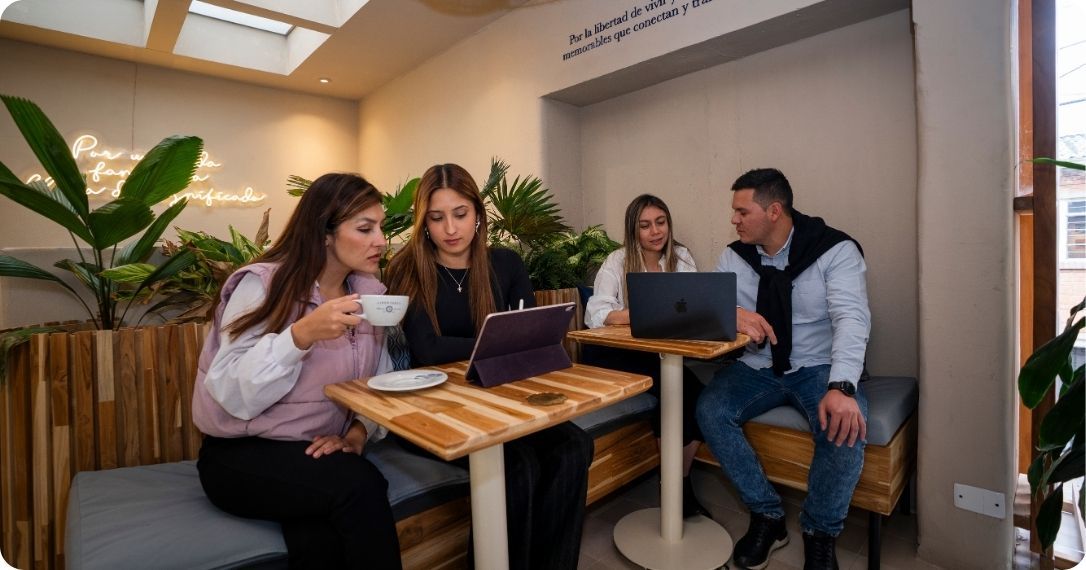
A company that invests in giving its team good places to work, spaces designed for focus, collaboration and wellbeing, is making a statement about how it values the people who work there. That signal matters for employee motivation because the perception of being valued is one of the most consistent predictors of engagement.
The cost of commuting
One of the most underestimated factors in the motivation equation is the commute. A long, exhausting journey consumes physical and mental energy before work even starts. The person arrives already depleted, with less tolerance, less creative capacity and less willingness to give more than the minimum.
In well-designed hybrid work models, giving people the option to work from a professional space close to where they live, rather than requiring them to commute to a distant central office, directly reduces that energy cost. The result is not just individual wellbeing: it is a team that arrives at their workday with more resources to put into the work itself.
Collective motivation, the kind that comes from belonging to a real team, is not built on video calls alone. It is built in the informal moments that happen when people share a physical space: the conversation before a meeting, the spontaneous lunch, the question someone asks out loud that turns out to be the same question someone else had.
Those moments are hard to schedule but they can be facilitated. When a team has easy access to spaces where they can meet, without complex logistics or weeks of advance booking, in-person encounters happen more naturally and more frequently. And that has a direct impact on team relationship quality and on individual employee motivation.

One invoice, less administrative friction
For anyone managing a team operationally, there is a practical argument that rarely gets mentioned in motivation discussions: managing workspace for a distributed team can be a significant administrative burden if it is not well resolved. Separate contracts per city, invoices from different providers, individual reimbursement processes, all of that creates friction that consumes time and energy.
A workspace network that consolidates everything under one subscription, with one invoice covering daily workspace access, meeting rooms and team event coordination, eliminates that friction. The result is more time available to focus on what actually matters: the people, not the contracts.

Conclusion
Employee motivation is not an attitude problem and it is not solved with one-off interventions. It is the accumulated result of concrete conditions: clarity, recognition, autonomy, a physical environment that works and team dynamics that function.
For anyone managing a team, that means improving motivation is not a task separate from day-to-day management. It is part of it. Every decision about how objectives are communicated, how feedback is given, how the workspace is designed and how people are spoken to in difficult moments has a cumulative effect on the team's level of commitment.
Teams with high employee motivation are not the ones with the best people. They are the ones operating in the best conditions. And those conditions can be designed, sustained and improved deliberately.
Frequently Asked Questions
Remote work
Keep up to date with our most recent articles, events and all that Pluria has to offer you.
By subscribing to the newsletter you agree with the privacy policy.

The future is hard to predict.
Unfortunately, there’s no crystal ball that can tell us exactly what will happen. Yet, there are structured methods that[...]
22 October, 2025

In today’s fast-paced business environment, projects move faster than ever before.
Customer expectations shift constantly, new competitors enter [...]
29 October, 2025

More often than not, the best ideas do not develop in a linear fashion.
As a matter of fact, they usually emerge from a single word, an unexpected conn[...]
07 November, 2025