

Hiring in LATAM for US Companies: EOR vs Contractors vs Local Entity

09 February, 2026
Share this article
Table of Contents
For many US companies, the decision to hire in Latin America does not begin as a bold global expansion strategy. It usually starts much more quietly.
A hard-to-fill role. A growing engineering backlog. A recommendation from another founder who “had great experiences hiring in Mexico.”
At first, it feels tactical. But very quickly, hiring in LATAM becomes structural.
Once a company decides to build a team outside the US, even a small one, it crosses an invisible line. From that moment on, the organization is no longer just experimenting with remote work. It is entering the territory of global expansion, whether it calls it that or not.
This is where many leadership teams pause. Not because the opportunity is unclear, but because the execution feels risky. Different hiring models promise speed, savings, or simplicity, yet each one introduces trade-offs that are rarely obvious at the beginning.
For any global expansion company exploring business with Latin America, the real question is not if LATAM makes sense. It is how to hire responsibly, sustainably, and at the right level of commitment.
This article is designed as decision support, not promotion.
We will walk through the three most common hiring models for US companies entering LATAM:
- Employer of Record (EOR)
- Independent contractors
- Creating a local legal entity
We will compare them across cost, speed, risk, scalability, and long-term viability, with specific attention to hiring in Mexico and broader hiring in LATAM.
If you are exploring business with Latin America seriously, this is not the breakdown one might expect, but frankly, the one leadership teams actually need.
What Is Global Expansion, Really?
Before diving into contracts and payroll, it helps to clarify what we actually mean when we talk about global expansion.
When people ask what is global expansion?, they often imagine opening offices, launching products in new countries, or setting up international sales operations. In reality, global expansion often starts with something much more personal: hiring people.
Hiring is the first moment where legal systems, tax obligations, cultural expectations, and operational realities collide. Unlike selling across borders, hiring creates long-term obligations, both formal and informal.
This is why hiring in LATAM has become such a common first step. It allows US companies to access talent without immediately committing to full market entry. However, this also means that many companies expand globally before they have a clear expansion strategy.
Latin America offers:
- Strong technical and professional talent pools
- Time zone alignment with the US
- Cultural proximity compared to other offshore regions
- Competitive cost comparisons without extreme trade-offs in quality
But expansion through hiring also introduces legal, tax, and cultural complexity much earlier than many teams expect.
This is where hiring models matter.

Why Hiring in LATAM Has Accelerated
The rise of Latin America as a hiring destination is not accidental, but opportunity-driven.
Over the last decade, LATAM has shifted from being perceived as an outsourcing region to becoming a strategic talent hub. This change did not happen overnight, nor is it driven by cost alone.
Countries like Argentina have seen rapid growth in tech, professional services, and distributed teams. Surveys and market reports consistently show that US companies are increasing their presence in the region, not just for outsourcing, but for core roles.
Meanwhile, Colombia has become a strong hiring destination for US companies, but its labor framework places heavy emphasis on formal employment, making long-term contractor arrangements especially sensitive from a misclassification perspective.
Several factors explain this shift:
- Mature remote work infrastructure after 2020
- Strong university systems and technical training
- A workforce already experienced working with US companies
- Cultural familiarity with US business norms compared to other regions
Hiring in Mexico, in particular, stands out because it combines geographic proximity, cultural familiarity, and a mature professional ecosystem.
In Brazil, hiring introduces additional complexity due to strict labor protections, a highly regulated payroll system, and mandatory benefits that significantly increase total employment cost beyond base salary.
Still, opportunity does not eliminate complexity. Hiring in LATAM means navigating unfamiliar labor laws, understanding tax or legal basics, and adapting to cultural differences that directly affect retention and engagement.
This is why the hiring model matters as much as the talent itself.
The Three Hiring Models US Companies Use in LATAM
When US companies hire in Latin America, they almost always choose one of three paths. Each one reflects a different level of commitment, risk tolerance, and maturity in the global expansion process.
There is no universally “right” option. There is only the right option for where your company is today.
Let’s look at them one by one.
1. Hiring Through an Employer of Record (EOR)
An Employer of Record allows a company to hire employees in a foreign country without setting up a local legal entity.
The EOR becomes the legal employer, while the US company manages the employee’s day-to-day work.
From an operational perspective, EORs feel simple. They handle contracts, payroll, benefits, and compliance. For leadership teams under time pressure, this model offers speed and reduced administrative burden.
This is why EORs are often the preferred option for companies hiring their first employees in LATAM or testing a new region. Hiring in Mexico through an EOR can often be done in weeks instead of months.
However, simplicity comes at a cost. EOR fees accumulate over time, and while they reduce legal exposure, they do not eliminate it entirely. Companies still need to understand what they are delegating and where responsibility remains shared.
How EORs Work in Practice
When using an EOR for hiring in LATAM:
- The EOR handles employment contracts, payroll, benefits, and local compliance
- You manage the day-to-day work, performance, and goals
- The employee is legally hired under local labor law
Speed and Simplicity
EORs are typically the fastest route to market. You can often hire within weeks rather than months.
This makes them attractive for:
- Early-stage expansion
- Pilot teams
- Testing a market before committing long-term
Cost Structure
EORs usually charge:
- A monthly fee per employee
- Or a percentage on top of gross salary
At a small scale, this is manageable. At a larger scale, it adds up.
In practice, EORs usually stop making sense once headcount reaches roughly 8–12 employees in the same country, as recurring fees begin to outweigh the simplicity they initially provide.
Cost comparisons matter here. While base salaries in LATAM are lower than in the US, EOR fees can narrow that gap over time.
Risk and Compliance
The biggest advantage of EORs is reduced legal risk. They handle:
- Labor law compliance
- Payroll taxes
- Mandatory benefits
However, responsibility is not eliminated, only shared. Misclassification or misuse of EOR structures can still create exposure if not handled properly.
When EORs Break
EORs tend to break down when:
- Headcount grows significantly
- You want more control over benefits and policies
- You need deeper integration with global payroll systems
- Costs start approaching the level of running your own entity
EORs are excellent for speed, but not always for scale.

2. Hiring Independent Contractors in LATAM
Hiring contractors is often the first instinct for US companies expanding into LATAM. It feels flexible, fast, and cost-efficient.
From a surface-level cost comparison, contractor arrangements appear attractive. There is no payroll, no benefits administration, and fewer formal obligations. For short-term projects or specialized roles, this model can work well.
The problem emerges when contractor relationships start to resemble employment.
In countries like Mexico, labor laws focus on the reality of the working relationship, not the contract label. If a contractor works full time, follows company schedules, uses internal tools, and reports like an employee, local authorities may reclassify the relationship.
This is where many companies misunderstand tax or legal basics and expose themselves to fines, back payments, and legal disputes.
In Argentina, for instance, frequent regulatory changes, inflation, and currency controls add an extra layer of operational risk, making cost predictability and long-term planning more challenging without a carefully chosen hiring model.
Contractor arrangements are generally safest for engagements under 6–9 months, after which continuity, dependency, and legal exposure start to resemble an employment relationship.
How Contractor Models Work
When hiring contractors:
- You engage individuals as independent service providers
- You pay invoices, not payroll
- There is no employment relationship on paper
This model is extremely common for contractor Mexico arrangements and short-term roles.
Cost and Flexibility
Contractors usually look cheaper at first glance:
- No benefits
- No payroll taxes (on your side)
- No long-term commitments
This makes cost comparisons attractive, especially for startups or project-based work.
The Legal Reality
Here is where many companies get into trouble.
In most LATAM countries, labor law is designed to protect workers. If a contractor:
- Works full-time
- Has fixed schedules
- Uses company tools
- Reports to a manager like an employee
Then legally, they may be considered an employee, regardless of the contract label.
This is one of the most misunderstood tax or legal basics of hiring in LATAM.
Misclassification risks include:
- Fines
- Back taxes
- Mandatory severance
- Legal disputes
When Contractors Make Sense
Contractors can be appropriate when:
- Work is genuinely project-based
- Engagements are short-term
- There is clear autonomy and independence
- You are testing collaboration, not building a core team
When Contractors Break
Contractor models break when:
- Roles become long-term and operational
- Team members expect stability and benefits
- Local authorities reclassify the relationship
- Cultural expectations around employment clash with contractor status
In many LATAM countries, long-term contractor arrangements feel precarious to workers, even if pay is competitive.
This affects retention more than many US companies anticipate.

3. Creating a Local Legal Entity
Creating a local legal entity is the most complex and resource-intensive option, but also the most stable.
With a local entity, the company hires employees directly, manages payroll, and assumes full compliance responsibility. For payroll Mexico, this means engaging with local tax authorities, social security systems, and labor regulations directly.
The upfront investment is significant. Legal setup, accounting, and compliance require time and expertise. But as headcount grows, the long-term cost structure often becomes more efficient than EOR models.
Beyond cost, a local entity sends a strong signal to employees. It communicates commitment, stability, and long-term presence. For companies planning deep business with Latin America, this model eventually becomes unavoidable.
What It Means to Open an Entity
Creating a local entity involves:
- Registering a company locally
- Opening bank accounts
- Managing local payroll
- Handling compliance, accounting, and reporting
For payroll Mexico, this means dealing directly with Mexican labor law, social security, and tax authorities.
Cost and Time Investment
This is the slowest and most expensive option upfront.
You will need:
- Legal counsel
- Accounting support
- Ongoing compliance management
However, long-term cost comparisons often favor entities once headcount grows beyond a certain point.
Creating a local entity typically starts to pay off once headcount grows beyond 10–15 roles, when fixed setup and compliance costs are spread across a stable and growing team.
Control and Stability
The biggest advantage of a local entity is control. You can:
- Design compensation and benefits
- Build long-term teams
- Reduce per-employee overhead
- Align policies with global culture
For employees, this often feels like the most stable and “real” setup.
When a Local Entity Makes Sense
Entities make sense when:
- LATAM hiring is strategic and long-term
- Headcount is growing consistently
- You want to reduce dependency on third parties
- You plan deeper business with Latin America beyond hiring
When Entities Are Overkill
They are usually unnecessary when:
- You are hiring one or two people
- Market commitment is still uncertain
- Speed matters more than optimization
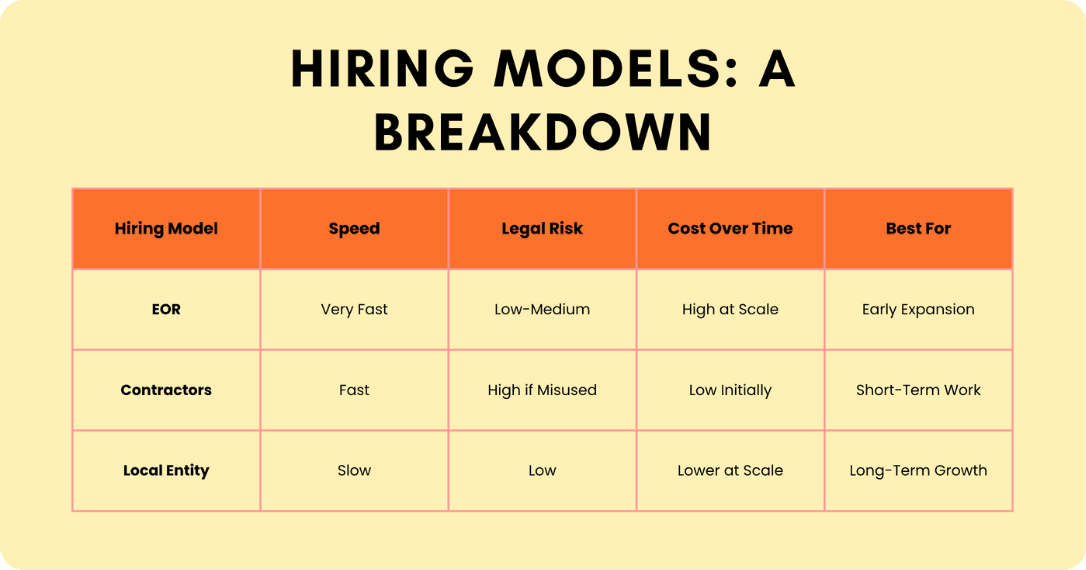
Across hiring models, clear thresholds tend to emerge in practice. EORs usually stop making sense beyond 8–12 employees per country. Contractor arrangements are safest under 6–9 month engagements. Local entities typically start to pay off once headcount grows past 10–15 roles. The comparison below shows how these models differ across speed, risk, cost, and long-term viability.
Below is a comparison of the three most common hiring models for US companies hiring in Latin America: Employer of Record (EOR), independent contractors, and setting up a local entity. The table compares speed, legal risk, cost over time, and best use cases for each model.
Cultural Differences That Shape Hiring Outcomes
Hiring models do not operate in a vacuum. Cultural differences in LATAM significantly influence how each model is perceived by employees.
In many Latin American countries, employment is closely tied to stability and long-term planning. Benefits, social security, and formal employment status carry emotional and social weight. This means that long-term contractor arrangements, even when well paid, can create insecurity.
In a follow-up article we will be exploring the main differences in expectations between the different countries in Latin America.
Understanding cultural differences is not about adjusting perks. It is about aligning the hiring model with local expectations of fairness, growth, and respect.
This is often where retention challenges appear, not because of compensation, but because of structure.
Cultural differences in LATAM affect:
- Expectations around job stability
- Communication styles
- Feedback and hierarchy
- Perceptions of contractors vs employees
For example, in many LATAM countries, employment is closely tied to identity and security. Offering only contractor roles for long-term positions can signal instability, even if compensation is strong.
Understanding cultural differences is not about stereotypes. It is about designing hiring structures that people actually want to stay in.

Choosing the Right Model Over Time
Most companies do not choose one model forever. They evolve.
A typical path looks like this:
- Contractors for early experimentation
- EOR for structured growth
- Local entity for long-term scale
The mistake is not choosing the “wrong” model initially. The mistake is failing to recognize when a model no longer fits the company’s reality.
Rather than asking “which model is best?”, better questions are:
- How fast do we need to hire?
- How long do we plan to stay?
- How many people will we hire in the next 12–24 months?
- How much legal risk are we willing to manage internally?
- What kind of relationship do we want with this team?
Final Thoughts: Hiring Is the First Real Commitment
Hiring in LATAM is often the first real, irreversible step in global expansion.
Market entry guides can help you understand regulations. Cost comparisons can help you build budgets. But hiring models define how your company actually shows up in a new region.
Whether you choose an EOR, contractors, or a local entity, the decision is less about paperwork and more about intent.
Are you testing? Are you building? Are you committing?
If you are serious about hiring in LATAM, clarity here will save you months of friction later.
And if you are still unsure, that is often a sign to slow down and design before executing.
Global expansion rarely fails because of talent. It fails because structure lags behind ambition.
Granted, there are probably many questions regarding hiring in LATAM. But keep in mind we’ll explore payroll specifics for different countries and other topics of interest in separate guides.
Beyond the legal structure, new hires in LATAM need a place to work. Providing workspace for your new hires from day one, without requiring a lease in every city, is one of the fastest ways to signal that the company is serious about its presence in the region."
Remote work
Keep up to date with our most recent articles, events and all that Pluria has to offer you.
By subscribing to the newsletter you agree with the privacy policy.

The future is hard to predict.
Unfortunately, there’s no crystal ball that can tell us exactly what will happen. Yet, there are structured methods that[...]
22 October, 2025

In today’s fast-paced business environment, projects move faster than ever before.
Customer expectations shift constantly, new competitors enter [...]
29 October, 2025

More often than not, the best ideas do not develop in a linear fashion.
As a matter of fact, they usually emerge from a single word, an unexpected conn[...]
07 November, 2025