

Human Resource Management: A Practical Guide for Leaders in 2026

07 May, 2026
Share this article
Table of Contents
A decade ago, the HR department operated within a relatively stable status quo: hire, manage, retain. The tools were familiar, the processes were standardized, and the biggest challenge was usually operational efficiency.
That way of working is no longer the norm, and in many organizations it has even become a liability.
Human resource management operates in a structurally different context in 2026: teams are distributed across multiple cities or countries, flexibility expectations have shifted, and artificial intelligence tools are redefining what work a person does versus what a system handles.
The HR leaders navigating this moment well are not the ones who found a new manual. They are the ones who understood that their role stopped being administrative and became strategic, and are rebuilding their practices from that foundation.
That shift has a name: strategic human resource management. And it is less a methodology than a change in how the function sees itself.
This guide covers what human resource management means today, how the role of the HR team has changed, what a modern system needs to include, and how managing people in hybrid and distributed teams requires a fundamentally different approach than the one that worked five years ago.
No filler theory. Just practical criteria for the moment we are actually in.

What Is Human Resource Management Today (and What Changed)
The classic answer to the question “what is human resource management?” describes it as the set of practices and processes an organization uses to attract, develop, and retain talent. And while the definition is technically correct, it is also no longer sufficient to describe what the role actually requires in practice.
Human resource management in 2026 is, first and foremost, a strategic function. Not a support area. Not the department that processes payroll and manages conflicts, but the function that makes decisions that directly affect an organization's capacity to grow, adapt, and compete.
That shift in position has concrete implications:
- Before, HR executed policies defined by the business. Now, HR co-designs the people strategy alongside executive leadership.
- Before, success was measured in process efficiency: time to hire, cost per hire, turnover rate. Now, it is also measured in cultural impact, adaptability, and the quality of internal leadership.
- Before, strategic human resource management was reactive. It responded to problems when they appeared. Now it is preemptive. It uses data to identify risks before they become crises.

Three forces transformed what it means to do human resource management effectively:
- 1. Work lost its fixed location. The widespread adoption of hybrid and remote work changed the relationship between person and organization. Managing someone who works from three different cities in a single month requires entirely different processes, tools, and talent management.
- 2. AI entered talent processes. Not as a future promise, but as an operational reality. From candidate screening to turnover risk analysis, AI is changing what decisions an HR team makes and how quickly it makes them. The challenge is not adopting the technology. It is knowing when human judgment remains irreplaceable.
- 3. Employee expectations changed. Flexibility, purpose, development, and wellbeing stopped being differentiators and became baseline conditions. The organization that ignores these expectations does not just lose talent. It loses the ability to attract it in the first place.
The Human Resources Manager in 2026
The human resources manager who hired people, ran payroll, and organized the end-of-year team dinner no longer exists, or should not.
What occupies that role today is something structurally different: a professional who combines strategic judgment, analytical capability, and genuine people sensibility in proportions that were not required together five years ago.
These are the four responsibilities that define the modern human resources manager:
Designing Culture in Distributed Environments
Building corporate culture when a team does not share a physical space is one of the most complex challenges HR faces today. It is not solved with virtual events or values posted on a wall. It is solved with organizational design decisions: how communication happens, how often, in what format, and what spaces are created for people to connect in a meaningful way.
Hybrid work well managed is not a logistics problem. It is a cultural design problem that the human resources manager has to lead, not just administer.
Managing Asynchronous Communication
In distributed teams, most collaboration happens asynchronously. That changes how decisions are made, how feedback is given, how work is recognized, and how early signs of disconnection or burnout are detected.
A human resources manager without a clear framework for asynchronous communication is managing a significant part of the employee experience blind. It is not a technology issue. It is a people leadership issue.

People Analytics as Standard Practice
Data-driven decision making is no longer exclusive to finance or product. Modern HR uses data to answer concrete questions:
- Which teams have the highest turnover risk in the next 90 days?
- Is there a correlation between the work model and engagement levels?
- Which managers are developing talent and which are burning it out?
Without these answers, people management operates on intuition where it should operate on evidence.
Integrating AI into Talent Processes
The modern HR function cannot ignore artificial intelligence, but it cannot adopt it without judgment either. The most mature applications today include:
- Automated candidate screening with bias reduction
- Predictive turnover risk analysis
- Personalized professional development pathways
- Onboarding assistants that scale the experience without scaling the team
The criterion that separates the HR teams doing this well is knowing exactly where AI improves the process and where human judgment remains irreplaceable. Automating screening makes sense. Automating the decision of who to promote does not.

What a Modern Human Resource Management System Needs
A human resource management system is not just software. It is the complete infrastructure that allows an HR team to operate consistently, make data-informed decisions, and scale its processes without losing quality in the employee experience.
The most common mistake is confusing the system with the tool.
An organization can have the most sophisticated HRMS on the market and still make people decisions with intuition and spreadsheets. And it can have modest tools but a human resource management system that works because it has clear processes, defined criteria, and metrics that are reviewed regularly.
When evaluating human resource management software, the question is not which platform has the most features. It is whether the system you are building has these five components:
- Full employee lifecycle management. The system must cover every stage with defined processes: how people are attracted, selected, onboarded, developed, retained, and, when the time comes, offboarded in an optimal way.
- Centralized people data. Without a single source of truth, the human resource management system operates in silos. Centralization is not a technology luxury. It is a requirement for making coherent decisions.
- Automation of administrative processes. Payroll, time management, onboarding documentation, contract renewals. Every repeatable, low-judgment process should be automated. Not to cut costs, but to free the HR team's capacity for work that genuinely requires human judgment.
- Continuous feedback and measurement tools. A modern human resource management software includes frequent pulse mechanisms, bidirectional feedback channels, and dashboards that surface trends before they become problems.
- Infrastructure for flexible work. A modern people management system needs to address how people work, not just where. That includes clear hybrid work policies, access to professional spaces when needed, and tools that support asynchronous collaboration.
Managing People in Hybrid and Distributed Teams
Managing people across teams that do not share a physical space is not a complicated version of traditional management. It is a different discipline.
The assumptions that worked in an office like culture built through proximity, feedback given in the hallway, or productivity measured by visibility, stop being valid when a team is distributed across three cities or four time zones.
These are the four shifts in judgment that define effective human resource management in hybrid environments:
From Visibility to Results
The most costly mistake in hybrid teams is continuing to evaluate people by their presence: how many hours they are online, how quickly they respond to messages, whether they show up to meetings even when they have nothing to contribute. That model destroys the autonomy that makes flexible work valuable.
Strategic human resource management in hybrid contexts evaluates results with clear criteria: what was committed to, what was delivered, and with what quality. The question is not "were you available?" but "did you deliver what we agreed on?"
From Uniformity to Structured Flexibility
Not every role, person, or moment of work requires the same thing. Some days demand deep focus and individual work. Others require in-person collaboration or access to a well-equipped professional space.
People management that treats everyone the same in a hybrid team generates unnecessary friction. What works is flexibility with structure: freedom to choose how and where to work, within a clear framework of expectations.
This is where tools like Pluria have a direct impact. Giving access to a network of professional coworking spaces is not just a logistical benefit. It is an organizational design decision that tells the employee: we trust your judgment, and we are putting real resources at your disposal so you can work well from wherever you need to.

From Control to Trust with Oversight
High-performing hybrid teams do not run on distributed micromanagement. They run on clear agreements, tools that support asynchronous collaboration, and managers who know how to give autonomy without losing the pulse of the team.
That requires a follow-up practice that is not disguised control. Regular check-ins focused on obstacles, not justification of hours. Team retrospectives that surface friction before it becomes a problem. A culture where asking for help is not perceived as a sign of weakness.
From Assumed Engagement to Measured Engagement
In an office, signs of disconnection are visible. In a distributed team, they are not. A person can be at active risk of resignation or burnout for weeks without any manager noticing, simply because the signals are not physically observable.
Employee satisfaction in hybrid teams requires active and frequent measurement. A biweekly or monthly pulse of three to five questions is enough to detect trends before they become resignation decisions.
How Pluria Supports Modern People Management
Most tools a human resources manager relies on solve administrative problems: payroll, contracts, onboarding documentation, time management. They are necessary, but they do not touch the employee's day-to-day experience.
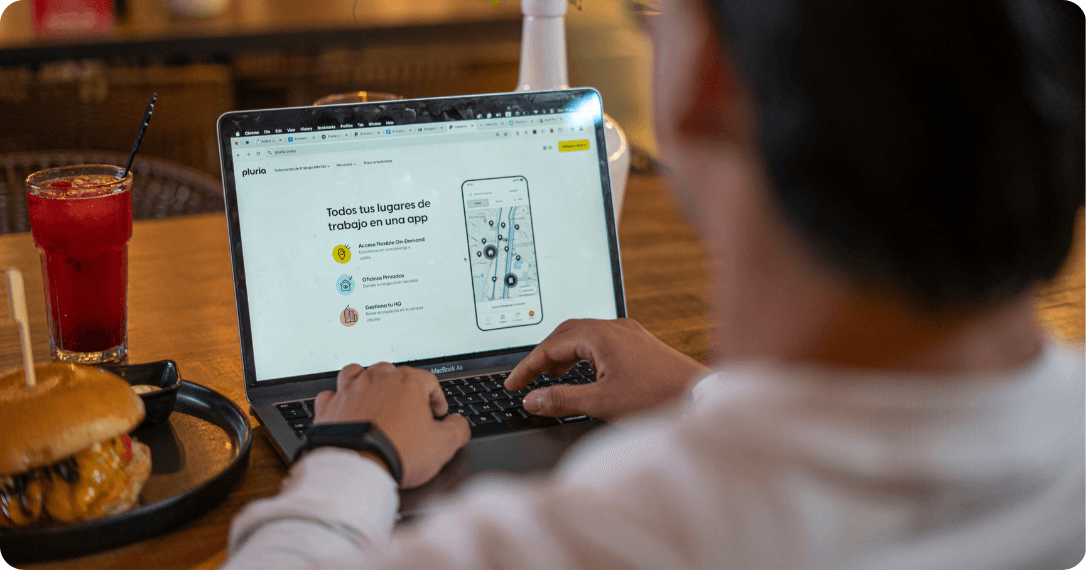
Pluria operates in a different layer. It is not an HRMS or management software. It is the infrastructure that makes professional flexible work possible, and that has a direct impact on how people experience their relationship with the organization every day.
For hybrid and distributed teams, Pluria resolves three concrete issues that modern human resource management faces:
- Flexibility without precarity: Giving freedom of workplace without that meaning working from a kitchen table or a café with a bad connection. The network of over 1,000 spaces across LATAM and Europe ensures that flexibility comes with a real professional environment.
- Non-monetary recognition: Access to quality workspaces functions as a signal of trust and investment in the employee experience. It is a benefit that gets used, felt, and remembered.
- Culture without a fixed office: One of the biggest challenges for distributed teams is maintaining cohesion without a shared space. Pluria allows teams that normally work remotely to gather in professional spaces when they need to, without the costs and commitments of a permanent office.
Organizations worldwide are already using this model to manage distributed teams with greater flexibility, lower fixed costs, and stronger engagement outcomes. You can see how they approached it in Pluria's success stories.
Conclusion
Human resource management was always a strategic function. The difference now is that there is less margin for operating as if it were not.
Teams are more distributed, expectations are higher, and the tools available, from artificial intelligence to flexible work infrastructure, change what is possible with the same resources. That is not a threat to the HR role. It is precisely the condition that makes the role more relevant than it has ever been.
What distinguishes the people leaders navigating this moment well is not that they have all the answers. It is that they stopped managing from assumptions that no longer hold, and started building systems that work for the way work actually happens today.
Strategic human resource management is not a framework or a certification. It is a way of seeing the function, and of acting from that perspective every day. That is the starting point. Not the technology, not the budget. The judgment.
FAQs
Remote work
Keep up to date with our most recent articles, events and all that Pluria has to offer you.
By subscribing to the newsletter you agree with the privacy policy.

The future is hard to predict.
Unfortunately, there’s no crystal ball that can tell us exactly what will happen. Yet, there are structured methods that[...]
22 October, 2025

In today’s fast-paced business environment, projects move faster than ever before.
Customer expectations shift constantly, new competitors enter [...]
29 October, 2025

More often than not, the best ideas do not develop in a linear fashion.
As a matter of fact, they usually emerge from a single word, an unexpected conn[...]
07 November, 2025