The Invisible Pay Cut in Mexico City

04 March, 2026
Share this article
Table of Contents
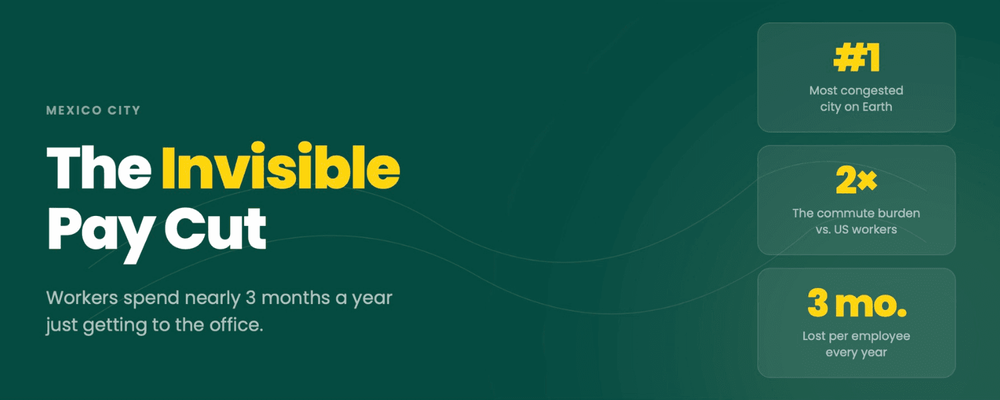
In Mexico City, commuting isn’t an inconvenience. It’s a structural tax. A new analysis by Pluria reveals that CDMX professionals lose about 475 hours per year to commuting, more than double the US average of 223 hours. The proportional burden is also far heavier: in some cases the commute absorbs between 27% and 65% of annual salary, roughly twice the impact seen in the United States.
As companies around the world push for return to office, one fact is often ignored: commuting is not free. In the United States, a widely cited 2025 analysis by MyPerfectResume found that the average worker loses 223 hours per year to commuting. Valued at the average American hourly wage, that lost time represents roughly $8,158, or about 11% of gross annual salary. Researchers called this the “invisible pay cut.”
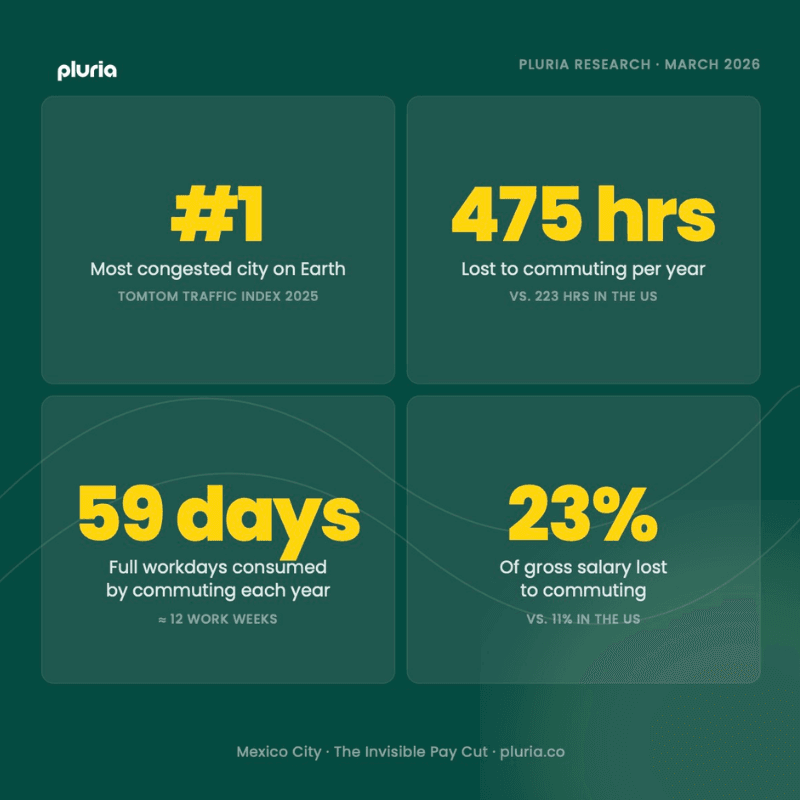
Pluria applied the same methodology to Mexico City, ranked the #1 most traffic congested city in the world by the TomTom Traffic Index 2025, and the results are striking. The invisible pay cut here is not just larger. In CDMX, the scale of the problem is structurally different.
Double the Time. Double the Burden.
According to INEGI’s Origin-Destination Survey, the average one way commute in the Mexico City metropolitan area is 57 minutes. That means almost two hours of every working day are spent traveling to and from the office. The Moovit Public Transit Index reports an even longer commute for transit users at 66 minutes one way, with 67% of riders spending more than two hours commuting every day.
Across 250 workdays, a 57 minute commute each way adds up to about 475 hours per year spent in transit. That is the equivalent of 59 full workdays, or nearly 12 working weeks.
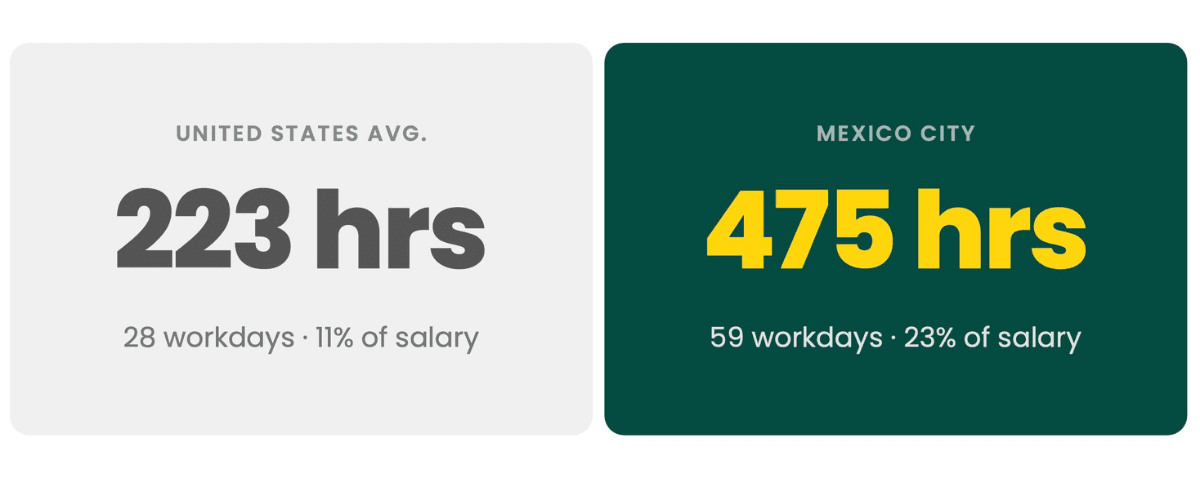
For comparison, the average American worker loses 223 hours per year to commuting, roughly 28 workdays.
When those 475 hours are valued at the average hourly rate for a CDMX professional, the cost represents about 23% of gross annual salary. In the United States, the equivalent burden is about 11%.
In both countries, this time is unpaid, unrecognized, and rarely included in compensation discussions.
Requiring a Mexico City employee to commute to a central office every day is equivalent to asking them to work from January through mid-March for free, just to sit in traffic.
Mexico City vs. the United States
The comparison is straightforward.
- An American worker loses 28 workdays and 11 cents of every dollar earned.
- A Mexico City worker loses 59 workdays and 23 cents of every dollar.
Same invisible pay cut. Twice the weight.
And this only accounts for the value of time lost. It does not include the out of pocket cost of transportation, which for many workers adds significantly to the burden.
The central office model effectively shifts this cost from the company to the employee. And employees notice.
The Consequences
Research from Harvard, Brown, and UCLA found that workers would give up about 25% of their total compensationfor remote or hybrid flexibility.
In Mexico City, many professionals are already giving away 23%. Not by choice, but by traffic.
The trade-off here is not ideological. It’s economic and the effects are visible.
Higher attrition risk.
Silent disengagement.
Upward salary pressure to compensate for commute pain. Reduced productivity from employees who arrive exhausted before the workday even begins.
A Pew Research study found that 46% of remote-capable workers would likely leave their job if remote work ended entirely. In a city with the world’s worst commute, that number is likely higher.
The Real Decision
Mexico City’s HR leaders face a real dilemma.
The central office model imposes an unsustainable commute tax. But fully remote work comes with its own costs, particularly in Mexico, where in-person relationships, trust building, and team cohesion are deeply woven into professional culture.
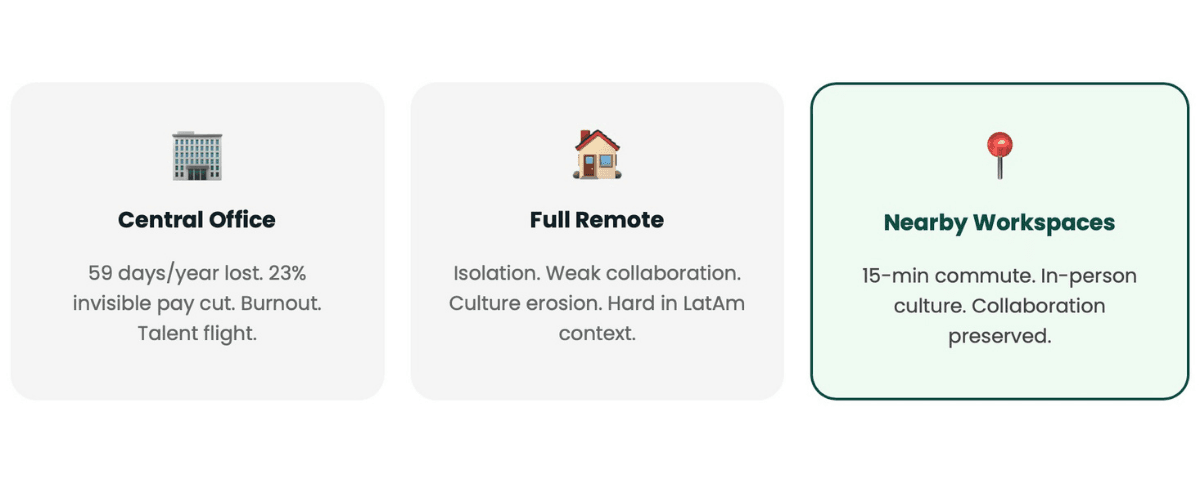 But the real decision is not office versus remote. It’s commute distance.
The structural problem in Mexico City is geography. Moving millions of employees across a 20 million person metropolitan area every day is inefficient by design.
The alternative is a distributed model.
Instead of concentrating everyone in a single central headquarters, companies provide access to professional workspaces close to where employees actually live. Teams meet in person, but without the 90 to 120 minute commute. The average travel time drops to 15 or 20 minutes.
Collaboration remains.
Culture remains.
The commute tax disappears.
When you reduce daily travel from two hours to twenty minutes, engagement does not require motivation campaigns. It follows naturally.
What if your team could collaborate in person without the commute?
Pluria gives companies access to a network of quality workspaces close to where employees live, across Latin America’s largest cities.
Cut the commute from 2 hours to 15 minutes and keep the team culture that makes collaboration work.
The Question for HR Leaders
Every five day RTO week in Mexico City costs each employee the equivalent of one full day of unpaid commuting. Over a year, that adds up to nearly three months lost to travel.
The invisible pay cut is real. It is measurable. And in this city it is twice as heavy as in the United States. The central office is not neutral. It redistributes cost in time, energy, and money from companies to employees.
Hybrid work in CDMX is not about offering flexibility as a perk. It is about removing structural friction from the system.
The question is no longer where people work. It is how close they can work to where they live, while staying coordinated with their teams.
About Pluria
Pluria helps companies enable distributed work through access to nearby professional workspaces across Latin America. It acts as a coordination layer for teams that need both proximity and connection.
Not flexibility as a benefit. Flexibility as infrastructure.
Leadership
Keep up to date with our most recent articles, events and all that Pluria has to offer you.
By subscribing to the newsletter you agree with the privacy policy.

Is the corporate world “better” than the entrepreneurial one? At times, one party goes after the other with loud statements that it’s much better on their side. And I have to admit, it happens very often on[...]
04 December, 2023

I have seen recently many hardcore fans of returning to office (one way or another most have direct skin in the game for this to happen, but that’s a different topic) who loudly proclaim that a physical off[...]
04 December, 2023

I was working from a dressing room (literally) for several months already, having online meetings and talking to clients among clothes hangers, shirts and shoes, with my son interrupting me for drawing pape[...]
04 December, 2023